
Commercial Kitchen vs. Co-Packer: When Should Your Food or Beverage Brand Make the Switch?
Still producing in a commercial or shared kitchen? Learn the signs it's time to switch to a co-packer, what changes, and a step-by-step plan to make the move.
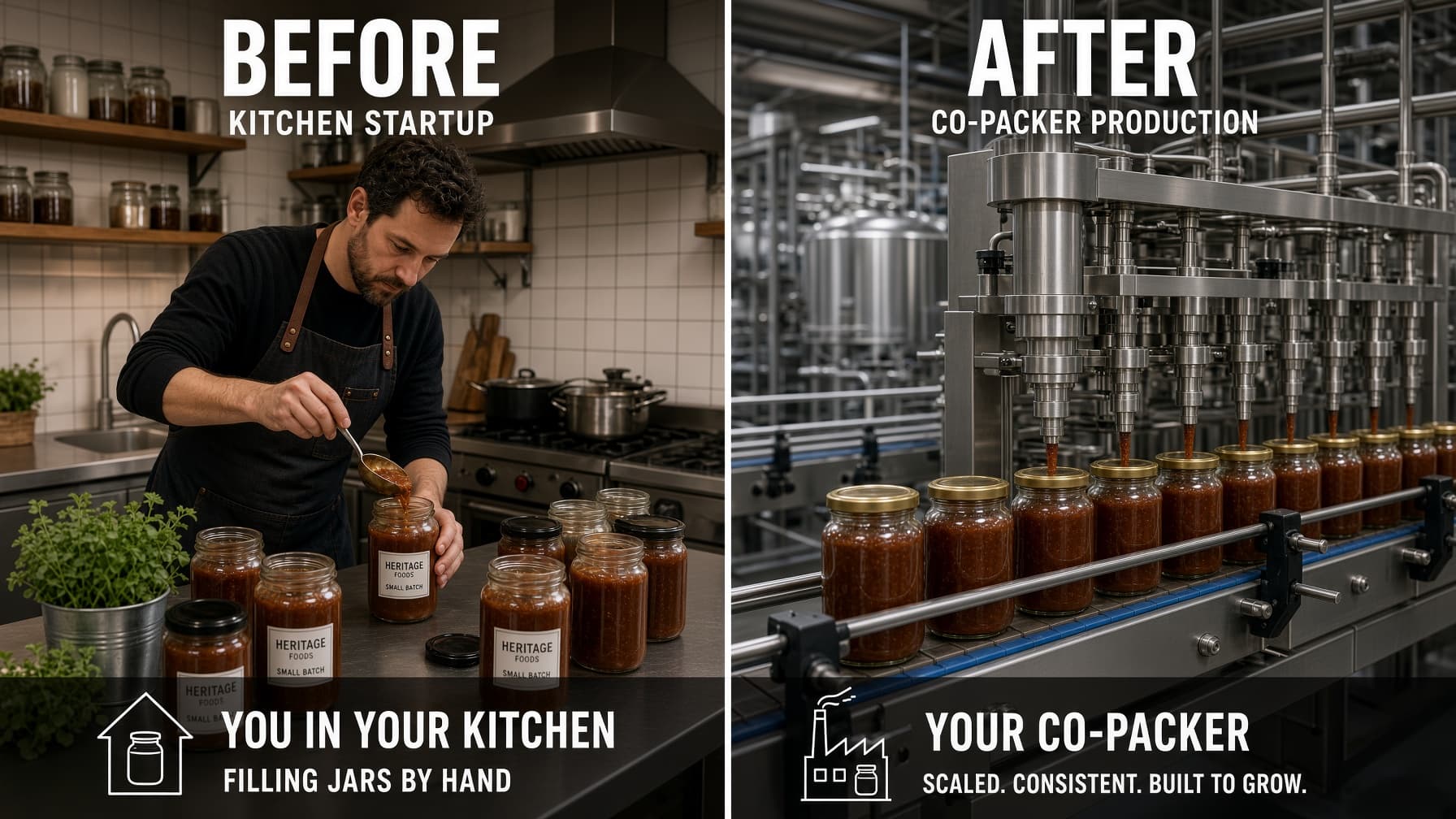
Almost every food and beverage brand starts the same way: a recipe, a rented shift in a commercial or shared-use kitchen, and a lot of late nights. That setup is perfect for testing a product with farmers market shoppers and a few local stores. But at some point, the kitchen stops being a launchpad and starts being a ceiling.
This guide breaks down the real differences between producing in a commercial kitchen and working with a co-packer (contract manufacturer), the signs that it's time to switch, what changes when you do, and how to make the move without losing the product your customers already love.
Commercial Kitchen vs. Co-Packer: The Core Difference
In a commercial kitchen (including shared-use kitchens, kitchen incubators, and commissary kitchens), you rent the space and equipment and do the production yourself. In a co-packer arrangement, a licensed manufacturer produces, fills, and often packages your product for you using their facility, equipment, staff, and food safety systems.
Here's how the two compare side by side:
Who makes the product: In a commercial kitchen, you and your team. With a co-packer, the manufacturer's trained staff.
Batch size: Kitchens limit you to small batches based on equipment and rental hours. Co-packers run larger batches built around their minimum order quantity (MOQ).
Upfront cost: Kitchens are low, typically hourly or monthly rent. Co-packers are higher because of MOQs, scale-up trials, and packaging and ingredient minimums.
Cost per unit: Usually higher in a kitchen, especially once you count your own labor. Usually lower with a co-packer at volume.
Control: Full hands-on control in a kitchen. Shared control with a co-packer, defined by specs, contracts, and approvals.
Food safety programs: Your responsibility to build and document in a kitchen. A co-packer runs its own programs, often with third-party audits.
Retail readiness: Kitchens work well for local and direct-to-consumer sales. Co-packers are built for distributors and larger retailers.
7 Signs You've Outgrown the Commercial Kitchen
You can't keep up with orders. If you are turning down wholesale accounts, rationing inventory, or constantly running out of stock, production capacity is now limiting revenue.
You are the bottleneck. If most of your week goes to cooking, filling, and labeling instead of selling, marketing, and building accounts, the business can't grow past your own hours.
Kitchen time is hard to book. Shared kitchens often have limited slots. When you're fighting for overnight shifts just to fill an order, it's a sign.
A retailer or distributor is asking for more. Larger buyers commonly ask for consistent supply, product liability insurance, lot coding, and sometimes a third-party food safety certification such as SQF or BRCGS. Those are much easier to meet with an established facility.
Your margins don't work at scale. When you add up rent, your own labor, and small-quantity ingredient and packaging prices, the cost per unit may be too high to support distributor and retailer margins.
Batch-to-batch consistency is slipping. Small-batch production by hand naturally varies. As you sell to more people, inconsistency becomes a brand risk.
You need equipment you can't justify buying. Hot-fill lines, retorts, bottling and canning lines, form-fill-seal machines, and similar equipment are expensive to own. A co-packer already has them.
When Staying in the Kitchen Still Makes Sense
A co-packer isn't the right answer for every brand at every stage. Staying in a commercial kitchen a little longer can be the smarter move if:
You're still changing the recipe, packaging, or positioning based on customer feedback.
Your total volume is well below the MOQs of co-packers in your category.
You don't yet have the cash to cover a first production run, packaging minimums, and a few months of inventory.
Your product depends on a hand process that hasn't been tested on commercial equipment yet.
Many brands use this time to get ready: locking the formula, writing specifications, and building sales so the first co-packer run sells through quickly.
What Changes When You Move to a Co-Packer
1. Your recipe becomes a formula
Kitchen recipes measured in cups and "to taste" need to become weight-based formulas with exact ingredient specs. Scaling up can change texture, flavor, and cooking times, so expect at least one scale-up or pilot run to dial it in. See Pilot Run vs. First Commercial Run for what to expect.
2. You'll work with minimum order quantities
Co-packers schedule production in runs, and each run has a minimum. That means more inventory, more cash tied up upfront, and a need to plan sales ahead of time. Our guide to MOQs, lead times and pricing walks through how to forecast this realistically.
3. Ingredient and packaging sourcing changes
Some co-packers source ingredients and packaging for you, some require you to supply them, and many do a mix. Clarify early who buys what, who holds inventory, and who carries the cost of waste or overruns.
4. Documentation gets more formal
Expect to provide or approve product specifications, labels, allergen information, and quality standards. Many facilities operate under HACCP or preventive controls plans and third-party audits. Learn more in Food Safety Beyond FDA.
5. Protecting your recipe matters more
You'll be sharing your formula with another company. Use an NDA and make sure your agreement is clear about who owns the formula. Read Protecting Your Recipe before you send anything.
6. Your role shifts from maker to brand owner
Instead of running production, you'll manage a manufacturing partner: forecasting, approving samples, reviewing runs, and keeping communication tight. That frees time to focus on sales and growth.
How to Make the Switch: A Step-by-Step Plan
Lock your product. Finalize the recipe, package size, and shelf-life goal so co-packers can quote accurately.
Document your specs. Convert your recipe to weights, list ingredient suppliers, and note any critical process steps such as cook temperature, pH, or fill temperature.
Know your numbers. Estimate monthly volume for the next 6 to 12 months, your target cost per unit, and how much cash you can commit to a first run.
Find co-packers who fit your category and volume. A sauce co-packer, a beverage bottler, and a bakery have very different equipment and minimums. Focus on facilities that already make products like yours.
Send a clear request for quote. Use our RFQ template so every manufacturer quotes the same thing.
Vet the facility. Ask about certifications, audit results, allergen handling, lead times, and references. Visit in person if you can.
Run a pilot or scale-up batch. Compare the result against your kitchen version side by side before approving a full run.
Plan the overlap. Keep some kitchen inventory or production capacity until your first co-packed run is approved, delivered, and selling.
For a full pre-launch checklist, see the First Production Run Checklist for Food Co-Packers.
Frequently Asked Questions
Is a co-packer cheaper than a commercial kitchen?
Per unit, usually yes, once you reach the co-packer's minimum volume and count the value of your own time. Upfront, a co-packer typically costs more because of MOQs, scale-up trials, and packaging minimums.
How much volume do I need before using a co-packer?
It depends heavily on the category and the facility. Some small-batch co-packers work with emerging brands at relatively low minimums, while large plants may require much bigger runs. The right answer is to find co-packers whose minimums match where your sales are today, not where you hope they'll be.
Can I use a co-packer and keep producing some items myself?
Yes. Many brands move their best-selling SKU to a co-packer first and keep limited editions or test products in the kitchen until they prove demand.
Will my product taste the same?
It can, but scale-up often requires small adjustments. That's why pilot runs and side-by-side comparisons are essential before you approve full production.
Do I need my own food safety plan if I use a co-packer?
The co-packer runs food safety programs inside its facility, but as the brand owner you still have responsibilities, such as accurate labeling, supplier approval if you provide ingredients, and recall readiness. Review our FDA Compliance & Regulatory Guide for an overview.
Ready to Move Beyond the Kitchen?
Finding a co-packer that fits your product, volume, and budget is the hardest part of the transition. USA Factory Network matches food and beverage brands with vetted U.S. manufacturers based on category, capabilities, and minimums, so you only talk to facilities that are a real fit.