
Shelf-Life Testing for Food & Beverage Brands: What to Know Before Your First Production Run
How long will your product really last? A practical guide to shelf-life testing, date labeling, and how to work with your co-packer to set a best-by date retailers and customers can trust.
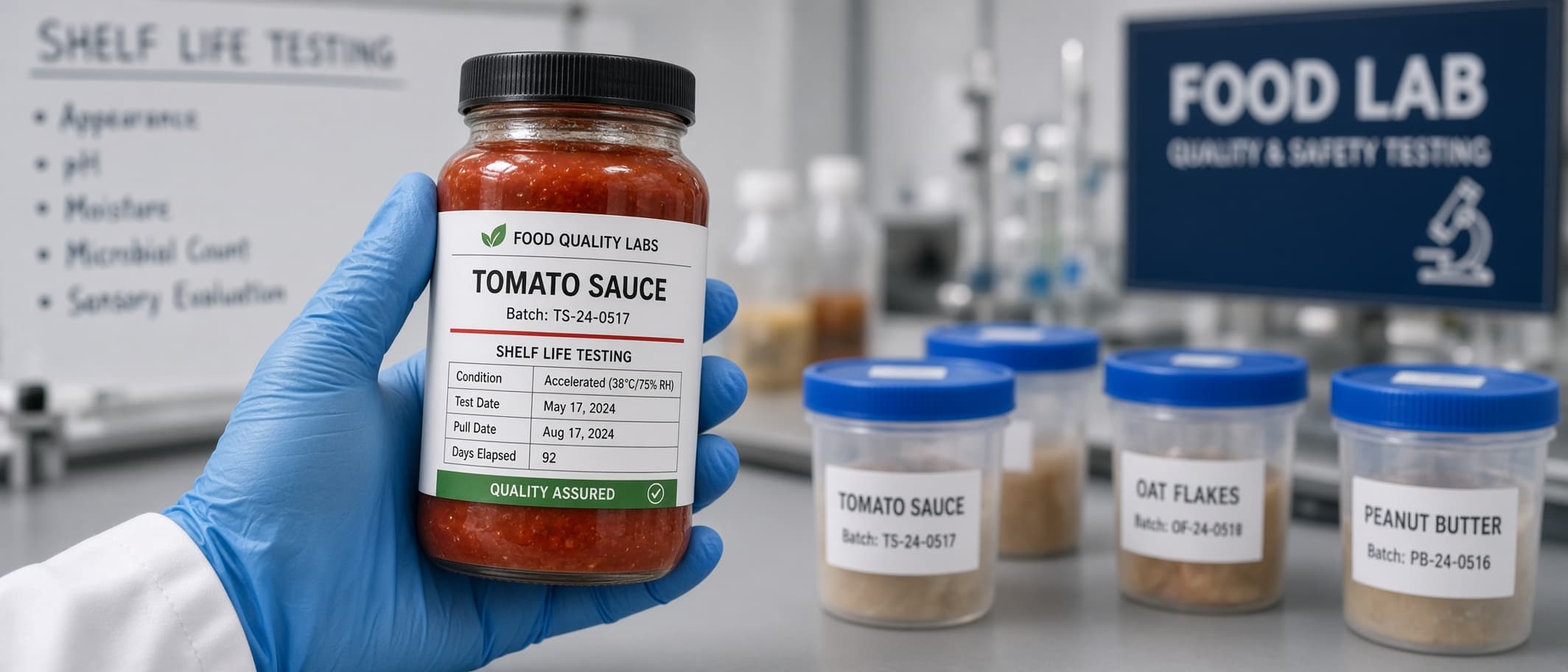
"How long does it last?" is one of the first questions a retail buyer, distributor, or co-packer will ask about your product – and "we think about six months" isn't a good enough answer. Shelf life affects your inventory planning, your distribution reach, your production run sizes, and your brand's reputation. Getting it right before your first production run can save you from costly recalls, returned product, and unhappy customers.
This guide explains what shelf-life testing is, how it works, and how to plan for it alongside your contract manufacturer.
What Is Shelf Life, Really?
Shelf life is how long your product stays safe and keeps the quality you intend – flavor, texture, color, aroma, and nutritional content – under expected storage conditions. Those are two separate questions:
Safety: Does the product stay free of harmful microbial growth or spoilage for the full period?
Quality: Does it still look, taste, and perform the way customers expect on the last day?
For many shelf-stable products, quality fades long before safety becomes a concern. A granola that goes stale or a beverage that changes color may be perfectly safe – but it's still a bad customer experience.
Is Date Labeling Required?
In the U.S., federal law doesn't require a date on most food products (infant formula is the main exception), though some states have their own date-labeling rules for certain products. In practice, though, most retailers and distributors expect a date code, and many will ask how you determined it. Common phrases include:
"Best if Used By" – the industry-preferred phrase for quality-based dates.
"Use By" – generally reserved for highly perishable products where quality or safety declines quickly.
Retailers also care about remaining shelf life at delivery. Many buyers require that a set portion of the shelf life remains when product arrives at their warehouse, so a short shelf life can limit which retailers and distributors will take your product.
What Affects Your Product's Shelf Life?
Water activity (aw): The amount of "free" water available for microbes and chemical reactions. Lower water activity generally means longer shelf life.
pH / acidity: More acidic products resist many types of microbial growth.
Processing: Pasteurization, retort, hot-fill, HPP, and other methods each deliver different results.
Ingredients: Fats and oils can go rancid; natural colors can fade; some preservatives extend life, while "clean label" formulas often shorten it.
Packaging: Oxygen and moisture barriers, light exposure, and seal integrity all matter. The same formula can have very different shelf lives in different packages.
Storage and distribution: Heat, humidity, and temperature swings during shipping can shorten real-world shelf life.
The Main Types of Shelf-Life Testing
Real-Time Testing
Product is stored under normal conditions and checked at regular intervals until it no longer meets your standards. It's the most accurate method, but it takes as long as the shelf life itself – a 12-month product takes 12 months to confirm.
Accelerated Testing
Product is stored under stressed conditions (usually higher heat and/or humidity) to speed up changes and estimate shelf life in weeks instead of months. It's useful for early estimates and launch timelines, but it's a prediction – it works better for some products than others, and it should ideally be confirmed with real-time data.
Challenge Studies
For products where safety is a concern (refrigerated, low-acid, or reduced-preservative foods), a lab may intentionally introduce specific microorganisms to confirm the formula and process keep them in check. Your co-packer or a food safety expert can tell you whether your product needs one.
What Gets Measured
A shelf-life study typically checks product at set time points for:
Microbiological results – such as total plate count, yeast and mold, or specific pathogens where relevant
Chemical changes – pH, water activity, rancidity markers, vitamin or active-ingredient levels
Sensory quality – taste, smell, texture, and appearance compared to fresh product
Packaging performance – seal integrity, swelling, leaks, or label issues
Tip: Define your "failure point" before testing starts. Is it a microbial limit? A noticeable flavor change? A texture that drops below a certain score? Clear criteria make the results far easier to act on.
Working with Your Co-Packer on Shelf Life
Your contract manufacturer is a key partner here – but don't assume they'll handle shelf-life testing automatically. Clarify early:
Who is responsible for testing? Some co-packers offer in-house or partner lab testing; others expect the brand to arrange it through a third-party lab.
Which samples will be tested? Samples should come from production made on the actual equipment, with the actual packaging. Kitchen or benchtop samples often behave differently.
What data do they already have? Manufacturers who produce similar products may have useful reference data for comparable formulas and packaging.
How will lot coding work? Agree on the date format and lot code so product can be traced and rotated correctly.
What triggers retesting? Any change to ingredients, suppliers, processing, or packaging can affect shelf life and may require new testing.
A Practical Timeline
During development: Measure pH and water activity early to understand your product's risk profile.
Before or during the pilot run: Pull samples from pilot production and start accelerated testing for an initial estimate, plus real-time testing to confirm it.
At launch: Use a conservative date based on the data you have. It's easier to extend a date later than to pull product off shelves.
After launch: Keep retained samples from each production lot and continue real-time monitoring.
Common Mistakes to Avoid
Guessing a shelf life based on similar products from other brands.
Testing homemade or benchtop batches instead of real production samples.
Changing packaging or suppliers without considering the impact on shelf life.
Choosing an aggressive date to satisfy a retailer before you have data to support it.
Forgetting about real-world distribution conditions like hot trucks and warehouses.
Quick Checklist
☐ Know your product's pH and water activity
☐ Decide whether you need real-time, accelerated, and/or challenge testing
☐ Confirm who's arranging testing – you or your co-packer
☐ Test samples from real production in final packaging
☐ Define clear pass/fail criteria before testing starts
☐ Agree on date format and lot coding with your manufacturer
☐ Check your target retailers' remaining shelf-life requirements
☐ Plan to retest after any formula, supplier, or packaging change
Note: This guide is general information. Shelf-life and food safety requirements depend on your specific product and process, so work with your co-packer, a qualified food lab, or a process authority for product-specific guidance.
Find a Manufacturer That Can Support Your Launch
The right co-packer will help you think through processing, packaging, and testing from day one. USA Factory Network matches food and beverage brands with vetted U.S. contract manufacturers based on your product, volumes, and certification needs.