
From Amazon FBA to Brick-and-Mortar: How Production Specs Change for Food & Beverage Brands
FBA-ready is not retail-ready. How case packs, pallet configs, date coding, GS1 labels, and retailer chargebacks change when a food or beverage brand moves from Amazon into grocery and mass.
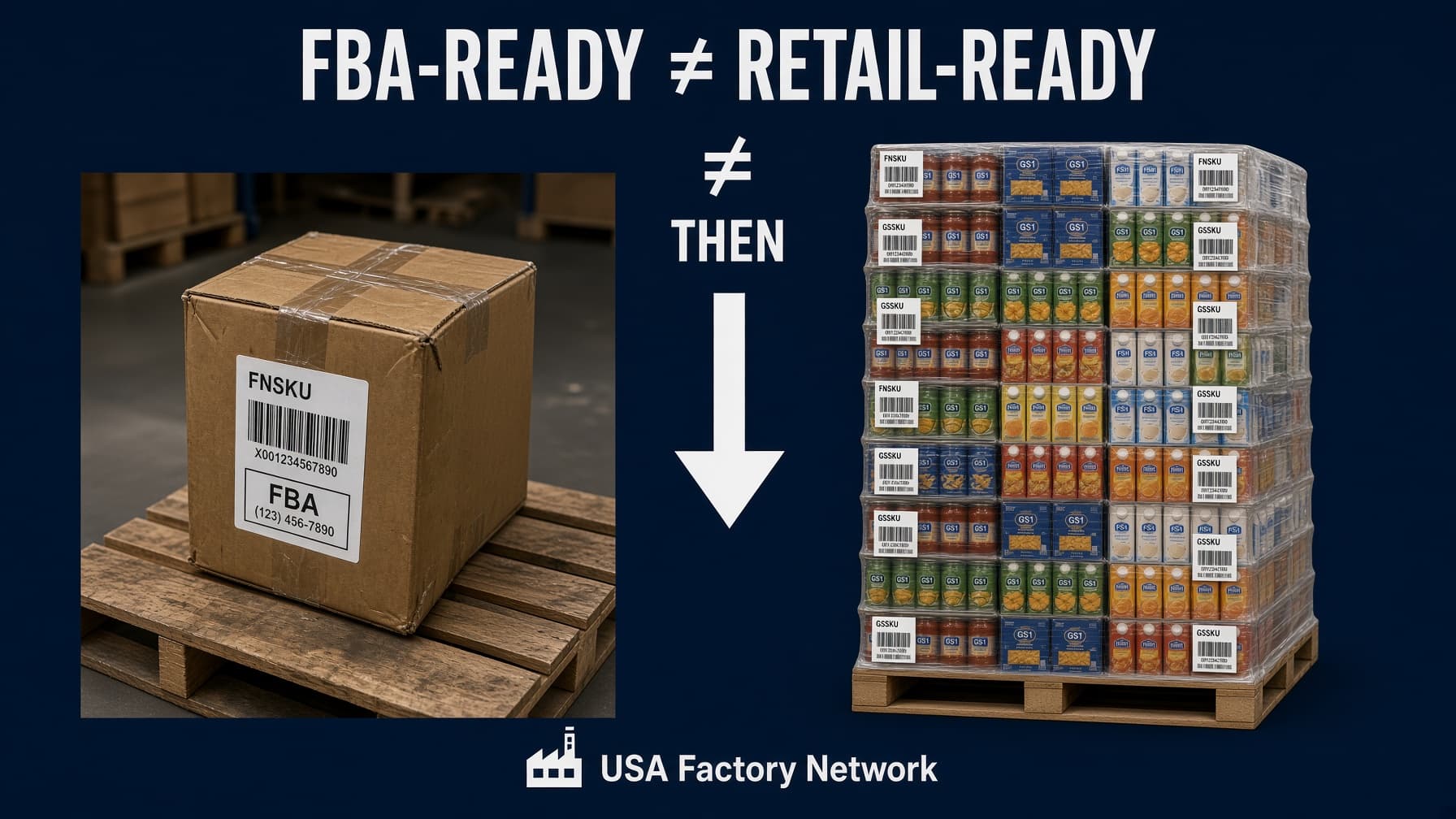
From Amazon FBA to Brick-and-Mortar: How Production Specs Change for Food & Beverage Brands
Amazon will take a case of 12 cans if the FNSKU is scannable and the box survives the inbound dock. A grocery DC will not.
When a food or beverage brand moves from FBA or Amazon Vendor into brick-and-mortar, the formula often stays the same. The packaging hierarchy does not. Unit, inner pack, case, and pallet all have to carry the right codes, dates, and dimensions for a retailer receiving dock. That is a manufacturing problem, not a 3PL problem. If your co-packer is still packing Amazon boxes, the first Target, Kroger, or Costco PO is where the chargebacks start.
FBA-ready is a unit problem. Retail-ready is a case-and-pallet problem.
On Amazon, the consumer unit is the hero. The fulfillment center breaks cases, labels singles, and picks them one at a time.
In grocery and mass, the case is the hero. Receiving scans a case barcode once. Slotting, planograms, backroom restock, and vendor scorecards all assume a stable case pack, a legal GTIN at every level, and a pallet that fits that retailer’s racking.
FBA labeling lives in Seller Central. Units need an FNSKU. Cartons get Amazon box IDs. Freight pallets get Amazon pallet IDs. Those labels are shipment-specific. They do not replace a retail case code, a case GTIN, or an ASN that matches what is physically on the dock.
Case pack is the first number that breaks a PO
Retail item setup starts with case pack: units per case, cases per layer, layers per pallet, cube, and weight.
A 12-can Amazon master that was packed “however it fit the box” may need to become a 24-can retail case with partitions and a printed case code. Variety packs and club multipacks are new SKUs. They need their own GTINs, not a handwritten mix. Case weight over about 40 to 50 pounds becomes a labor and chargeback issue at some banners, so the pack-out has to be designed before you freeze the bottle count.
Ask the co-packer: Can you run two pack-outs of the same formula — an FBA carton and a retail case — without a full changeover charge every time?
Pallet config: Amazon’s cap is not the store’s cap
A common FBA inbound planning baseline is a 40-by-48-inch GMA pallet, four-way entry, no overhang, stretch-wrapped to the deck, roughly 72 inches high including the pallet, and about 1,500 pounds including the pallet, with labels on all four sides. Confirm the current inbound guide for your node. Amazon updates these rules.
Grocery and club banners use the same footprint and then set their own height and weight caps. Costco-style clubs often bind height. Amazon often binds weight. If you sell both, you design to the tighter constraint or you build two pallet patterns.
Retail DCs also care about stack stability, corner boards and top sheets for glass and cans, single-SKU pallets, and whether mixed SKUs are allowed at all. Some banners specify Chep, PECO, or white wood.
Pallet pattern belongs in the co-packer packet next to the dieline, not in an email to the 3PL the week before the first PO.
Date coding: visible on the unit is not enough
Amazon grocery and consumables generally need a readable expiration or best-by on the unit. Inbound product that will expire inside the fulfillment center’s window — vendor manuals have used thresholds such as 90 days of life remaining at receive — can be rejected or chargebacked. The date on the bottle must match the date on the case.
Retail goes further. Dates and lots should match across every packaging layer: unit, inner, case, and often the pallet label.
Common GS1 application identifiers cover lot or batch, production date, packaging date, best before, and expiration. Barcode dates are typically encoded YYMMDD. Human-readable text on the case has to agree with the barcode. “Best by 09/26” on the can and a different expiration on the case is how receiving writes you up.
Ask the plant:
Can inkjet, laser, or thermal transfer hit the unit and the case in the same run?
Can lot and date pass through to a GS1-128 without a manual spreadsheet?
What open-date policy can you support if a retailer wants two-thirds of life remaining when the DC receives the freight?
GS1: FNSKU gets you into Amazon. GTIN and SSCC get you into stores.
Brick-and-mortar receiving expects a GS1 identifier at each level: a UPC or EAN on the unit, a separate GTIN on any inner multipack, a case GTIN on the carton, and an SSCC on the logistic pallet.
Retailer case labels usually also carry PO number, item number, quantity, lot, and dates. A label built for Walmart will not satisfy Target or Kroger. Two adjacent sides is a common case-label rule. Pallet label count and placement differ by banner.
The physical label must match the ASN. If the ASN says 48 cases of lot A and the dock scans lot B, the shipment is late before it is unloaded.
Lock these before first retail production:
A GS1 company prefix and a GTIN tree for unit, inner, and case.
Who prints case labels — co-packer, 3PL, or you.
Whether the plant can encode GTIN, lot, and best-by or expiration in one pass.
A photographed sample case and pallet in the buyer’s spec, not just a PDF.
Chargebacks are the expensive part of “we’ll figure packing later”
Amazon fees are mostly inbound and prep. Retail compliance deductions come from wrong case pack, missing GS1-128, no ASN, mixed pallet, date code not on the required sides, pallet over height, missing PO number, or cube that does not match item setup.
Those deductions hit the brand unless the co-packer agreement says otherwise. Most plants will reprint a label. Few will eat a first-PO deduction because the case GTIN was never assigned.
Put channel rules in the manufacturing packet: approved case pack and pallet pattern per channel, a label placement map for unit, case, and pallet, a date and lot hierarchy rule, and a clear split of who owns non-compliance if the plant packed the approved spec versus if the brand sent the wrong dieline.
What to send your co-packer when you add retail
Do not ask for “retail packaging.” Send a one-page channel spec.
Name the channel. List unit UPC and case GTIN. State units per case, cases per pallet, TI-HI, max height, and max weight. Specify carton style and whether Amazon prep is still required on a parallel run. Define date type and minimum life at receive. Name the label file owner and printer. Give first-PO volume and a realistic ongoing forecast so changeovers are quoted honestly.
USA Factory Network matches brands with FDA-registered U.S. facilities on product type, fill technology, certifications, MOQ, and location. If you need a plant that can run an FBA carton this month and a GS1-compliant grocery case next quarter, put both pack-outs in the request.
Submit at usafactorynet.com. Matches typically come back within 48 hours.